Home > Travel Guide > Transportation > Driving Around Lefkada
Driving around Lefkada is manageable for a careful driver, but the island is slower than it looks on a map. Main coastal routes are straightforward; beach approaches and inland village roads can become narrow, steep, winding, or busy with parked vehicles. Plan one part of the island per day and treat navigation times as a starting estimate, not an appointment.
You can drive onto Lefkada without a ferry
Lefkada connects to mainland Greece by a 50-metre floating swing bridge, according to official Visit Greece information. A normal road journey brings you onto the island; you do not load the vehicle onto a ferry simply to enter Lefkada.
The bridge is part of a working navigation and traffic system, so occasional short delays can occur. Follow signals, barriers, and staff instructions rather than trying to predict passage from an old timetable.
What driving around Lefkada feels like
Lefkada Town and the northern entrance
Traffic, junctions, scooters, pedestrians, deliveries, and parking create the main challenge. Drive defensively and watch for people crossing between parked vehicles. The fastest-looking lane is not always useful when a bridge movement or summer queue compresses traffic.
East coast and major villages
The east side links populated places and tourist services, so expect a mix of local traffic, buses, motorcycles, and vehicles turning into accommodation or businesses. Progress can be steady, but summer activity makes stopping distances and attention important.
West coast
Routes to Agios Nikitas, Kathisma, Athani, and the famous beaches curve around hills and villages. The sea may appear close while the road still has substantial bends and elevation to cover.
Inland Lefkada
Village streets can narrow between buildings, while mountain roads include blind bends and changing gradients. Slow before the bend rather than braking halfway through it, and be ready to meet a larger vehicle.
Beach access roads
Porto Katsiki, Gialos, Ammoussa, Agiofili, and other beaches have different final approaches. Conditions can change after weather, maintenance, or temporary works. Check current local information before taking an unfamiliar minor road.
Why driving around Lefkada takes longer than map times
A route planner cannot fully account for:
- meeting traffic on a narrow section;
- a bus or delivery vehicle passing through a village;
- searching for legal parking;
- walking from the vehicle to the beach;
- bridge or road-work delays;
- summer congestion near a popular entrance;
- stopping safely for passengers who feel unwell on bends.
Add margin instead of driving faster. A ten-minute delay is harmless when the day has one geographic focus and stressful when three beach arrivals were scheduled precisely.
Driving around Lefkada: the one-direction-per-day rule
Choose southwest, northwest, south, east, or town/inland as the day’s main direction. Complete the beach, meal, and evening in that region where possible. Crossing from Porto Katsiki to Lefkada Town and back south for dinner is technically possible but rarely pleasant.
This approach also makes weather changes easier. If the west coast is rough, redirect the entire day toward a sheltered southern or eastern bay rather than zigzagging between exposed beaches.
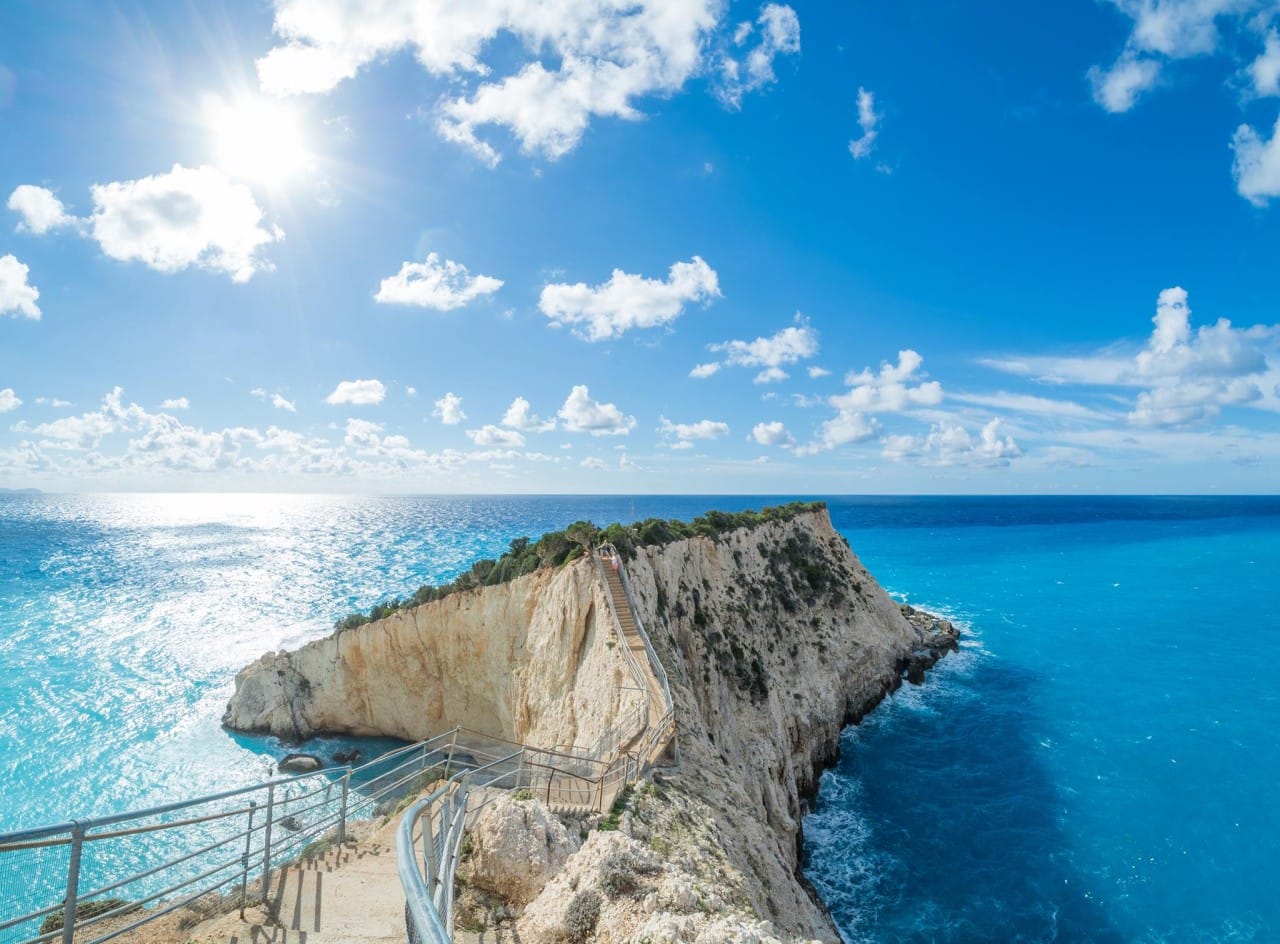
Driving to Porto Katsiki
The final route leads to parking above the beach. In July and August, arrive before 10:00 AM for a more convenient space and less pressure around the access area. There is no practical free parking within a reasonable walk.
Porto Katsiki Beach has no entrance fee. Drivers typically pay approximately €10 per vehicle for high-season parking, cash only, with slight variation possible by season or operator. The walk from the parking area to the top of the stairs takes only a few minutes.
Do not stop on a bend for a distant photograph, create a roadside space, or reverse into moving traffic because the closest parking is full. Follow directions from the parking operator and leave turning routes clear. See the Porto Katsiki parking guide for the complete cost distinction.
Driving around Lefkada on narrow roads
Reduce speed early and identify the nearest wider point. The smaller car does not automatically have priority, and the driver who arrived first is not always the one best placed to manoeuvre. Communicate calmly, use mirrors, and avoid forcing a motorcycle or pedestrian against the edge.
If reversing is required, move slowly and use a passenger as a guide only from a safe visible position—not directly behind the car. Do not allow a queue to pressure you into an unsafe gap.
Village driving etiquette
Village streets are living spaces, not shortcuts. Expect a resident stepping from a doorway, a cat or dog, outdoor seating, a delivery, or a vehicle stopped briefly for a practical reason.
- Slow down before entering the narrow centre.
- Keep noise low, especially at night.
- Do not block a gate, doorway, bin, turning point, or delivery access.
- Use a designated area and walk when the centre is pedestrianized or clearly unsuitable.
- Give pedestrians space rather than making them press against buildings.
Parking while driving around Lefkada
A space is not legal or sensible merely because another car occupies the shoulder. Read signs and road markings, follow local instructions, and consider whether a bus, emergency vehicle, or turning driver can still pass.
At beaches, identify the exit route before leaving the car. At villages, parking a little outside the centre is usually easier than searching narrow streets. At Lefkada Town, use established parking areas and walk rather than circling the pedestrian core repeatedly.
Never leave valuables visible. Check that windows are closed, the handbrake is secure on a slope, and the vehicle is not over dry vegetation that could contact a hot underside.
Fuel, charging, and vehicle checks
Refuel before a long southwest or inland day instead of waiting for the warning light. The Hellenic Police advises checking the vehicle before a journey; for an island day, that means tyres, lights, fuel, mirrors, and any warning indicator.
If using an electric vehicle, confirm compatible charging locations and access before the battery becomes a route constraint. Do not assume a charger shown in an old listing is available, working, or unrestricted.
Keep the rental or roadside-assistance number available offline. Photograph existing vehicle damage before departure if you are collecting a rental, but leave contract and insurance decisions to the separate rental-car planning process.
Driving after dark
Night removes many of the visual cues that make a winding road comfortable: the horizon, cliff shape, village edges, and the next bend. Animals, pedestrians, scooters, or unlit obstacles can also be harder to see.
Plan the first trip to remote accommodation in daylight when possible. After sunset, reduce speed, use headlights appropriately, avoid staring at oncoming glare, and pull over only in a genuinely safe place if navigation needs attention.
Sunset at a west-coast beach is easiest when the return route is road-level, as at Kathisma. Porto Katsiki adds a stair climb before the drive; Egremni adds a much longer access route. Leave before exhaustion dictates the journey.
Weather and temporary road conditions
Heavy rain, wind, rockfall, maintenance, or resurfacing can change a route. The Hellenic Police advises checking weather and road-network conditions before travel in bad weather. The Municipality of Lefkada publishes temporary traffic measures when works require them.
Do not drive past a closure because a navigation app still shows the road. Follow signs and police or municipal instructions. After severe weather, ask locally before using a remote beach road or unpaved shortcut.
Scooters, motorcycles, and ATVs
A two-wheeler is easier to park but less forgiving on gravel, polished surfaces, strong wind, and blind bends. The Hellenic Police states that both motorcycle riders and passengers must wear helmets. Use the appropriate licence and vehicle specified by the rental agreement.
Do not overtake a queue blindly, ride along the centre line on bends, or assume a beach road is easier because the vehicle is narrow. Carrying large beach bags can disturb balance; secure luggage properly.
Driving with children or passengers prone to motion sickness
The Hellenic Police advises placing children in the back and securing them properly. Use the correct restraint for the child and vehicle; confirm it before leaving the rental desk or accommodation.
For motion sickness, seat passengers where appropriate, keep the cabin cool, plan pauses before discomfort becomes urgent, and avoid a sequence of mountain crossings. A stable passenger matters more than reaching the beach ten minutes earlier.
Core road-safety rules worth repeating
Official Hellenic Police guidance emphasizes obeying the traffic code and speed limits, stopping at STOP signs, giving way appropriately, using seatbelts, securing children, wearing motorcycle helmets, and never driving after alcohol or drugs. These are not optional holiday adjustments.
Use 112 for an emergency. Describe the road, nearest village or beach, direction of travel, and any visible landmark. A shared map pin can help, but do not stand in live traffic while using the phone.
Offline navigation and phone use
Download the relevant map area and save the accommodation, parking, and meeting points before leaving reliable reception. A phone should be mounted and set before moving; a passenger can handle changes.
Navigation may suggest a minor road that is theoretically shorter. When signs, surface, width, or local instructions disagree, use the safer established route. Turn around only where visibility and space permit.
A practical driving around Lefkada checklist
- Fuel or charge is sufficient.
- Cash is available for Porto Katsiki parking.
- Weather and temporary road information have been checked.
- The route stays mainly in one geographic area.
- Parking and final beach access are understood.
- Return occurs before the driver is exhausted.
- Roadside-assistance and emergency numbers are available offline.
Driving Around Lefkada FAQ
Is Lefkada difficult to drive around?
Most careful drivers can manage it. The challenge is not motorway complexity but narrow village sections, bends, gradients, parking, and slower-than-expected beach approaches.
Do I need a ferry to take a car onto Lefkada?
No. A floating swing bridge connects the island to mainland Greece.
Can I drive around the whole island in one day?
A broad circuit is possible, but it is a poor sightseeing plan. Choose one or two connected areas if you want time outside the vehicle.
Are roads to the beaches paved?
Many main approaches are paved, but the final condition, maintenance, and parking surface vary by beach and season. Check current information and do not assume every minor route is suitable.
Is a small car better?
A compact car can be easier in narrow streets and parking spaces, provided it meets passenger, luggage, road, and rental needs. Vehicle condition and driver confidence matter more than choosing the smallest possible model.
Should I drive to Porto Katsiki or take a boat?
Drive for control over arrival time and the viewpoint; use a boat to avoid road parking and stairs. Boat operation and time ashore depend on the operator and sea conditions.
Where can I check closures?
Use current municipal and police announcements, road signs, accommodation hosts, rental companies, or other reliable local sources. Do not depend only on map routing.
The driving mindset that works
Lefkada rewards the driver who stops measuring success by distance. Leave margin, use one direction per day, park without obstructing local life, and let a narrow bend take the time it needs. The beaches will still be there after the bus passes.
Island-entry facts and safety guidance checked against Visit Greece, the Hellenic Police road-safety guide, and current municipal announcements. Temporary conditions can change.