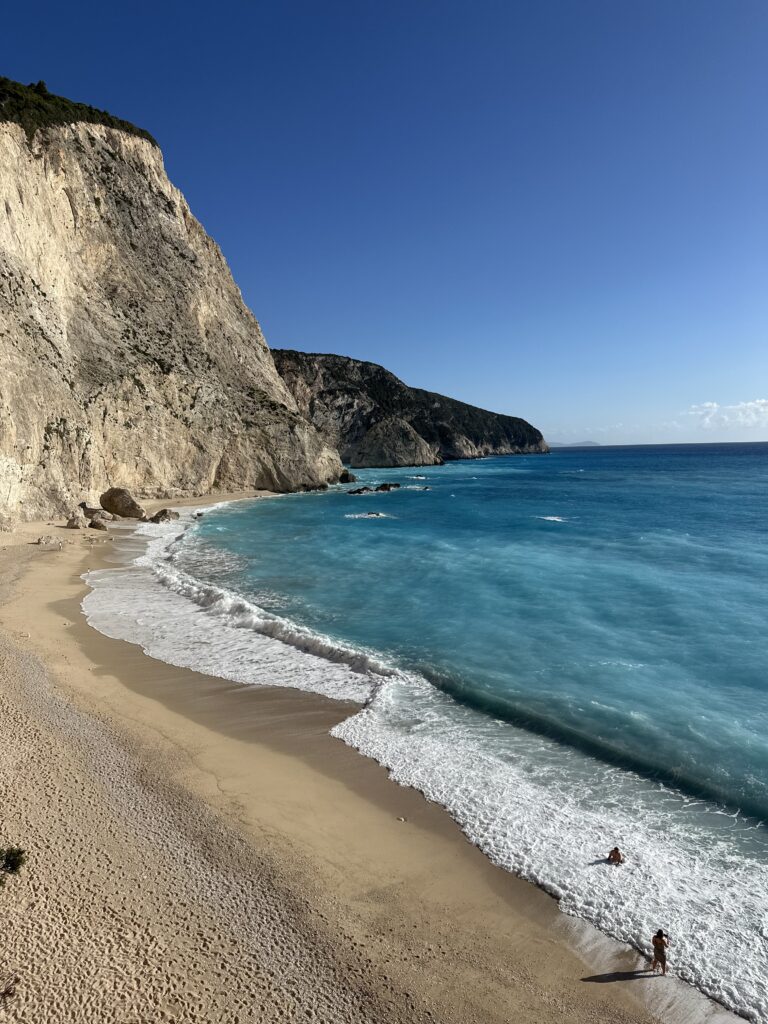
Porto Katsiki water color can look pale turquoise from the cliff, electric blue at the shoreline and deep cobalt farther offshore—all on the same day. The color is not a filter or a single permanent shade. That is why Porto Katsiki water color can change within minutes as light and viewing angle shift. It comes from the way sunlight behaves in water, combined with depth, the bright seabed, suspended mineral particles and the viewing angle.
Why Porto Katsiki water color looks blue
Water absorbs more of the red part of visible light while blue wavelengths remain more noticeable to our eyes. That is the basic reason clear seas appear blue. The effect becomes stronger as light travels through a greater depth of water, which is why the Ionian beyond the swimming area often looks much darker than the shallows.
The US National Ocean Service explanation of ocean color also notes that floating sediment and particles can change the hue by reflecting light. At Porto Katsiki, that helps explain why moving water close to the pale cliff can take on a milky blue appearance.
The role of the white cliff and pale seabed
The beach sits below a bright limestone cliff, and the nearshore bottom is covered with light-colored pebbles and rock fragments. In shallow water, sunlight reaches this pale surface and is reflected back through the water. Seen from the staircase or viewpoint, those bright shallows appear turquoise beside the darker water beyond them.
This is also why the color changes abruptly in places. A deeper channel, shadow or submerged drop-off sends less reflected light back to the viewer, creating a blue band even when the water itself is equally clear.
Why waves can make the sea look milky turquoise
West-coast swell breaks directly onto the pebbles. The backwash moves fine pale material through the shallows, increasing the number of particles that scatter light. The result can be an opaque-looking turquoise strip along the shore while the water farther out remains transparent blue.
“Milky” does not automatically mean dirty. After a calm period, fewer particles remain suspended and the shallows often look clearer. After stronger wave action, the color can become brighter but visibility beneath the surface may be reduced.
How the color changes through the day
When the sun is high, more light reaches the water and pale bottom, producing the strongest contrast between turquoise shallows and dark offshore blue. Earlier in the morning, parts of the beach sit in the cliff’s shadow and the sea can look cooler or flatter in photographs. Late in the day, lower, warmer light softens the turquoise and adds silver reflections to the surface.
There is no single “best” hour for everyone. Midday gives intense color from above; later light is often kinder for people, cliff texture and wider landscape photographs.
Cloud, wind and sea state
- Clear sky: stronger illumination and the familiar bright blue-to-turquoise contrast.
- Thin cloud: softer color with fewer hard reflections.
- Heavy cloud: grey sky reflected at the surface can mute the blue.
- Calm water: clearer views into the shallows and more even color.
- Waves: white foam and suspended pale particles can make the shore look brighter and less transparent.
Why photographs do not all match
A phone photographed from the clifftop records a different scene from a camera held at water level. From above, the lens sees the light seabed through shallow water. At beach level, it looks across a longer path of water and catches more surface reflection. Camera processing, polarizing sunglasses and edited saturation can widen the difference further.
If your own image looks less turquoise than the view, lower the exposure slightly so the bright cliff does not wash out the water. Clean the phone lens, avoid digital zoom and take one frame from the upper viewpoint before descending.
Photography positions for natural color
The staircase and the clifftop arrival area reveal the gradient most clearly: pale water at the beach, richer blue over greater depth and the dark open Ionian beyond. On the beach, use the cliff or a person for scale rather than filling the frame only with water.
A circular polarizing filter can reduce glare on a camera, but rotate it gently; too much polarization can create an uneven dark patch in a wide blue sky. Phone users usually get a more believable result by controlling exposure rather than applying a heavy color filter.
Does turquoise water mean it is shallow or safe?
Color is not a safety signal. Pale water often corresponds with a lighter or shallower bottom, but wave energy, sudden depth changes and shore break cannot be judged reliably from hue. Look at the moving sea in front of you and follow current conditions rather than treating a bright color as proof of easy swimming.
Water-color questions
Why is Porto Katsiki so turquoise?
Sunlight passing through shallow clear water and reflecting from the pale seabed creates the turquoise appearance. Fine light-colored particles stirred by waves can make it look even milkier near shore.
Is the blue color caused by chemicals or dye?
No. It is a natural optical effect involving water, light, depth, the seabed and suspended particles.
When is the color strongest?
Bright, high sunlight usually produces the greatest contrast from the viewpoint above the beach. Clouds, shadows and rough water change how the same sea appears.
Why does the water sometimes look cloudy?
Waves can suspend fine pale material in the shallows. This scatters light and reduces underwater visibility while producing a luminous turquoise band.
Is Porto Katsiki always the same blue?
No. The visible color changes with depth, sun angle, cloud, surface reflection, waves and where you stand.
The remarkable part of Porto Katsiki’s color is not one perfect shade but the transition across the bay. Pause above the stairs before going down: that height makes the relationship between the pale shore, changing depth and open Ionian blue easiest to see.